



Understanding Relational and Non-Relational Databases
DATABASEEN-US
Lucas Lumertz
4/5/20253 min read


Hey everyone, ready to figure out this whole relational and non-relational database thing? Haha, all jokes aside, have you ever stopped to think about how the apps and websites you use every day store so much information? From your Instagram profile to the products you buy on Amazon, all of it is kept in databases.
But did you know there are two main types? Relational and Non-Relational. They work in different ways, and today I'm going to explain in a super easy way how each one works, what they're used for, and why they are essential. Let's get started!
What Are Relational and Non-Relational Databases?
Relational Databases (SQL):
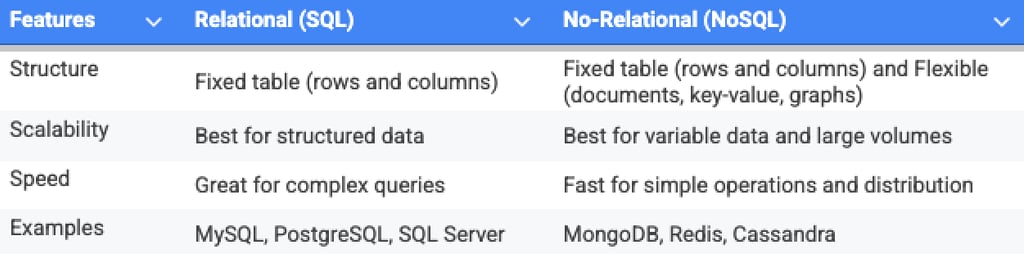
Imagine an Excel spreadsheet, where each column has a type of information (name, age, email) and each row is a record (a person, for example). Relational databases organize data into well-structured tables, where everything has a specific place.
Example: If you have an online store, you might have one table for customers, another for products, and another for orders, and they are all connected, it's that simple.
Non-Relational Databases (NoSQL):
Now, think of a toy box where you can just throw different things in without a fixed order. Non-relational databases are more flexible and don't require tables. They store data in formats such as documents (JSON), key-value pairs, graphs, among other different types of structure.
Example: A social media app can store posts, comments, and likes in different formats without needing a rigid structure like the relational one.
Main Differences:
I've put together a table to show you how super simple it is to differentiate the two. Let's take a look:
What Are They Used For?
Now that we understand a little about the difference between them and their main characteristics, let's look at the most common purposes of each one.
Relational:
✔ Systems that require consistency (like banks and finance).
✔ Data that doesn't change much (customer registrations, inventory).
✔ Complex queries (reports, advanced filters).
Non-Relational:
✔ Applications that grow very fast (social media, IoT).
✔ Data that changes constantly (news feeds, online games).
✔ Systems that require high speed (real-time analysis).
Why Are They Important?
Imagine trying to save all your WhatsApp messages in a spreadsheet—as much as I love spreadsheets, that would be a mess! Databases exist for this, among other things, such as:
Organizing information efficiently.
Ensuring that data isn't lost.
Allowing quick searches (like when you look for a product on Amazon).
Scaling as needed (an app that starts small and becomes huge, like TikTok).
Tools and Real-World Use Cases:
To make it a little easier, I'll show some tools and examples with more real-world scenarios.
Relational Databases (SQL):
MySQL → Used in blogs (WordPress) and web systems.
PostgreSQL → Popular in enterprise applications.
SQLite → A lightweight database used in mobile apps.
Use Cases:
Banking System → Transactions need to be exact and secure.
E-commerce → Orders, customers, and products in related tables.
Non-Relational Databases (NoSQL):
MongoDB → Stores data in JSON format, used by companies like eBay and Forbes.
Redis → Key-value database, great for caching (Twitter, GitHub).
Cassandra → Used for Big Data (Netflix, Instagram).
Use Cases:
Social Media → Posts, comments, and likes in flexible formats.
Online Games → Data from millions of players in real-time.
IoT (Internet of Things) → Sensors that generate variable data.
Well, we're coming to the end of another topic... no need to be sad, haha, there's more next month. So, let's summarize what we learned:
🔹 Relational Databases (SQL) → Organized tables, great for fixed data and complex queries.
🔹 Non-Relational Databases (NoSQL) → Flexible, ideal for data that changes a lot and grows fast.
🔹 Each has its own use → It depends on the type of application (financial system vs. social network).
🔹 Different tools → MySQL, PostgreSQL (SQL) vs. MongoDB, Redis (NoSQL).
If you are starting in the data world, understanding this difference is essential! Plus, in my opinion, SQL should be the first technical thing you study to move beyond spreadsheets.
And now, when someone mentions SQL or NoSQL, you already know what they're talking about and won't be lost anymore.
So, did you like it? Leave your comment and tell me what you thought! 🚀
📌 Want to learn more about technology and the data field? Follow me for more content like this! All the best!!