



Difference Between Machine Learning and Artificial Intelligence: Understand Simply
ARTIFICIAL INTELLIGENCEMACHINE LEARNINGEN-US
Lucas Lumertz
11/1/20253 min read


Hey everyone! Now that we understand what AI and ML are from the previous articles, you might have a question that I also had when I started studying the world of data and technology, which is:
💭 "What is the difference between Artificial Intelligence and Machine Learning?"
These two terms appear all the time in the news, on social media, in movies, and even in tools we use daily. But, although they are highly connected, they are not the same thing.
In this article, I'm going to explain in a simplified way what each one is, what they are used for, what their differences are, the tools that use them, and real examples that show all this in practice.
If you are a beginner and want to start understanding the universe of AI and Machine Learning, this text is the ideal starting point. 🚀
What Is Each One?
🤖 What is Artificial Intelligence (AI)?
Artificial Intelligence is a field of computer science that seeks to make machines think and make decisions in a way similar to human beings.
It is the large "umbrella" that encompasses several different technologies, including Machine Learning itself.
Example:
AI is like the human brain trying to imitate our intelligence. It analyzes data, learns from experiences, and makes decisions based on that.
It is behind virtual assistants (like Alexa and Google Assistant), autonomous cars, language translators, and recommendation systems.
📊 What is Machine Learning (ML)?
Machine Learning is a subfield within Artificial Intelligence.
It focuses on teaching machines to learn from data, instead of just following fixed commands.
Example:
While AI tries to "act like a human," Machine Learning tries to "learn like a human."
In Machine Learning, the computer analyzes examples (data), finds patterns, and uses that to predict results. This is how YouTube recommends videos similar to ones you've already watched.
What Is AI Used For?
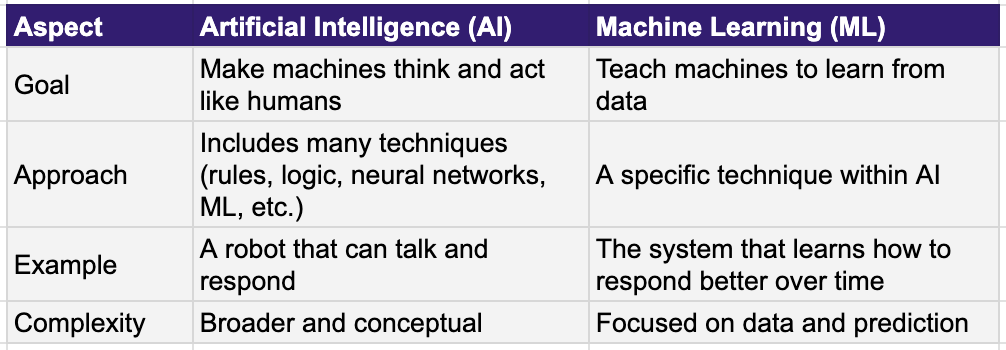
Both are used to automate tasks and make smart decisions, but in different ways. Let's analyze the table below:
In summary:
All Machine Learning is part of Artificial Intelligence, but not all Artificial Intelligence uses Machine Learning.
The Importance of These Technologies:
We live in an era where data is the new oil. AI and ML are the tools that refine this data and transform it into value.
Without them, the following would not exist:
Recommendation systems like Netflix and Spotify.
Automatic translators that learn new languages.
Computer-assisted medical diagnoses.
Digital security tools that detect fraud.
These technologies are shaping the present and the future, from simple tasks to critical decisions in companies, governments, and hospitals.
Tools and Practical Examples:
Artificial Intelligence Tools:
ChatGPT (OpenAI): uses AI to understand language and generate text.
Google Bard / Gemini: processes information and answers complex questions.
Siri / Alexa: interpret voice commands and interact like humans.
These tools combine various areas of AI, such as: speech recognition, natural language processing, and machine learning.
Machine Learning Tools:
Scikit-learn: a Python library for training predictive models.
TensorFlow and PyTorch: platforms used to create neural networks and deep learning models.
Power BI with AI: allows you to apply forecasting algorithms directly in dashboards.
Machine Learning is much more focused on data analysis and predictions.
Practical Example of the Difference:
A chatbot (AI) chats with the user.
But the one who "teaches" the chatbot to understand questions and improve responses is Machine Learning.
Use Cases That Show the Difference:
Artificial Intelligence:
Virtual assistants like Alexa and Siri, which converse and understand commands.
Autonomous cars, which make decisions about acceleration, braking, and steering.
Automatic language translation on Google Translate.
Machine Learning:
Netflix and Spotify, which recommend movies and music based on your history.
Banks, which use ML to detect fraud in real-time.
E-commerce, which predicts products you will likely want to buy.
Do you see the difference?
AI is the complete system that performs the task.
Machine Learning is the brain inside it that learns and improves performance over time.
Recap and Conclusion:
Let's recap what we learned:
Artificial Intelligence is the field that seeks to create intelligent machines.
Machine Learning is one of the ways to achieve this, by teaching machines to learn from data.
AI is broader, while ML is more specific and technical.
Both are fundamental for transforming data into smart decisions.
If I could summarize it in one sentence:
Artificial Intelligence is the whole. Machine Learning is one of the parts that brings that whole to life.
These technologies are already part of our daily lives, and the more we understand about them, the more prepared we are for the future.
Did you like the explanation?
👉 Share this article with someone else who also wants to understand the universe of AI and Machine Learning simply.
If you want to continue learning about data, artificial intelligence, and technology, follow me on social media, because we have new articles at the beginning of every month and informative content on Instagram. 💡 See you next time, all the best!