



Data Engineering Fundamentals: Exploring the Heart of the Data World
DATAFAVORITEEN-US
Lucas Lumertz
12/19/20244 min read


Hey everyone! Is everyone doing well? I really hope so. I was thinking about the next topic and realized I haven't talked about the fundamentals of data engineering yet, so I prepared this super easy article for you. Let's go!
I believe that through our other conversations, it's become a little clearer that the modern world runs on data. But have you ever stopped to think about how the information we see in reports, dashboards, and applications actually reaches us? Behind all that "magic" is a fundamental field called Data Engineering! I'm biased, but I absolutely love this area! Haha. In this article, I'm going to explain what it is, how it works, and why it is so essential for any business that wants to stand out in the market. Let's get started, everyone!
What Is Data Engineering and What Is It Used For?
Data engineering is like building a road so that data can travel safely and quickly from one point to another. The Data Engineer's job is to create, manage, and optimize the paths that data travels on, ensuring it is ready and organized for anyone who needs to use it, such as data scientists, analysts, and even managers.
Example: Imagine you own a restaurant. To understand how to improve your sales, we'll need to organize information like the best-selling dishes, peak hours, and customer profiles. Data engineering is the process that connects all this information, organizes it, and prepares it so you can make better decisions for your business, both in the present and for the future.
Why Are the Fundamentals of Data Engineering Important?
Okay, but why are these fundamentals important, Lucão? Relax, come with me. We can think of the fundamentals as the roots of a tree: without them, everything would collapse. Understanding the basic concepts of data engineering ensures that systems are robust, efficient, and prepared to grow as demand increases. This includes everything from knowing how to capture data to storing it securely and making it available quickly when needed.
If you skip the fundamentals, you run the risk of creating systems that don't work well, that crash as data increases, that present incorrect information, or, even worse, that are very expensive for the company.
The Data Engineering Lifecycle
Below, we can see an image that illustrates a bit about the process of the data engineering lifecycle:
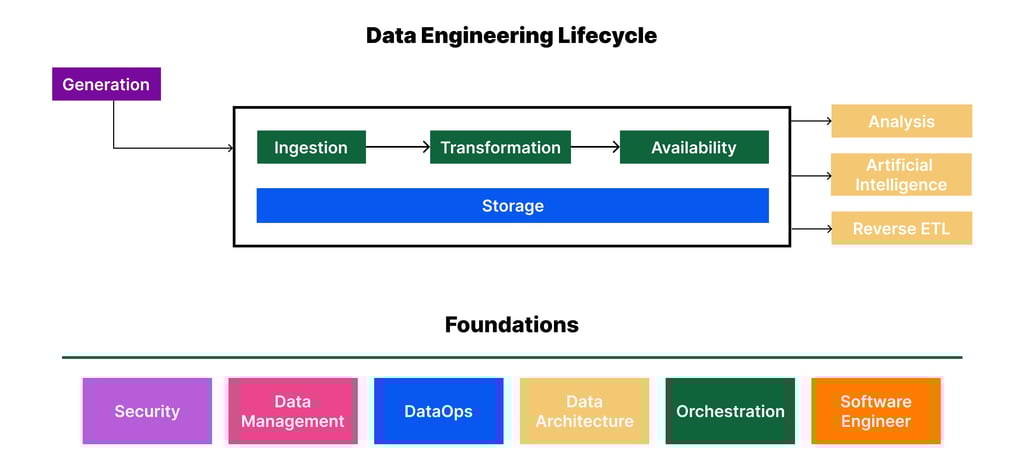
Now that we understand what data engineering is, let's dive into its lifecycle, a fundamental stage of the process that we need to understand. This cycle describes all the steps that data goes through, from its origin until it is used. Here are the main phases:
1. Data Generation:
Everything starts with the origin of the data. Data Generation is the starting point of the entire cycle. It's the moment when data is "born" from various sources. These sources can be internal systems (like a store's sales system), user interactions in applications, IoT sensors, social media, or even system logs. Example: In the restaurant, data can come from the point-of-sale system, customer reviews on Google, and Instagram posts.
2. Ingestion:
This is the process of capturing this data and bringing it into the system. Ingestion can be in real-time (streaming) or in batches (batch). Example: In the restaurant, the day's sales are loaded into a central system every night.
3. Transformation:
Here, the data is organized, cleaned, and converted into the necessary format. This often involves removing errors or duplicates, filling in missing information, and calculating useful metrics. Example: In the restaurant, you might calculate the profit per dish by combining sales and cost information.
4. Storage:
After being transformed, the data needs to be stored in a safe and accessible place. This could be a traditional database or a data lake, among others, depending on the need. Example: The restaurant's data is stored in a cloud database, allowing it to be accessed from anywhere.
5. Availability:
Finally, the data needs to be accessible to those who will use it. This can be through APIs, reports, or dashboards. Example: The restaurant managers access daily reports to make decisions based on the data provided.
6. Orchestration:
Orchestration means ensuring that all the steps in the cycle happen in the right order and at the right time. Tools like Apache Airflow or Prefect help us automate and monitor these processes so that they occur correctly and as expected. Example: In the restaurant, a system can automate the ingestion of data every night and transform the information immediately afterward.
The data engineering lifecycle ensures that data flows efficiently and securely, from its creation until the moment it is used. Each stage plays an essential role in guaranteeing that the data is ready to help with decision-making or to feed advanced systems like AI and machine learning.
This organization is what differentiates robust, scalable, and reliable systems from systems that crash or present incorrect and meaningless data.
Trends in Data Engineering
Just like any technology area, data engineering is always evolving and transforming. Here are some trends that, in my view, are gaining strength:
DataOps: A set of practices aimed at making data work more agile and collaborative, similar to DevOps for software development.
Data Mesh: An emerging concept that proposes decentralizing data management, making each team responsible for its own datasets.
Automation: Tools that automate repetitive tasks, such as data cleaning and transformation, are helping engineers dedicate themselves to more strategic work.
Machine Learning and AI: The use of Artificial Intelligence to predict problems and optimize data flow is a very strong trend.
Well, I think it's very clear that data engineering is the foundation of any data-driven strategy. Without it, it would be impossible to collect, organize, and use information efficiently. The engineering lifecycle shows us how essential each step is for transforming raw data into valuable insights for every area of the business.
Whether it's for creating a simple system or dealing with an enormous volume of data, the fundamentals of data engineering ensure that everything works well, even over time. And with trends pointing toward more automation and decentralization, the field promises to continue evolving very rapidly.
In the end, data engineering is like a bridge that connects the chaotic world of data to the clarity needed for important decisions. And, just like a well-built bridge, it needs solid foundations to support the weight of the future.
I hope this article has helped you understand the pillars of this incredible field! All the best, and until the next topic. 😊 🚀